Author(s): Nanette Goodman, Fatma Altunkol Wise, Fitore Hyseni, Lauren Gilbert, & Peter Blanck
Citation:
Goodman, N., Wise, F. A., Hyseni, F., Gilbert, L., & Blanck, P. (2024). Disability Inclusion in Corporate Supplier Diversity Initiatives. Journal of occupational rehabilitation, 10.1007/s10926-024-10190-2. Advance online publication. https://doi.org/10.1007/s10926-024-10190-2
Download Publication
Visit Website
Overview:
Purpose: Since the 1960s, federal and state governments and private-sector companies have used supplier diversity initiatives to ensure their supply chains include businesses owned by traditionally economically disadvantaged or underrepresented groups. Originally concentrated on racial and ethnic minority groups, programs have expanded to include businesses owned by women, veterans, LGBTQ+ individuals, and, in some cases, people with disabilities. This study investigates the extent to which disability is included in supplier diversity initiatives of Fortune 500 companies.
Methods: This paper uses a novel data set created by the authors with information on supplier diversity initiatives and Disability, Equity, and Inclusion (DEI) statements in Fortune 500 companies extracted from public sources. This information is combined with data from Compustat, a corporate financial database published by Standard and Poor’s and additional variables from other sources.
Results: 75% of the Fortune 500 companies have supplier diversity programs that express a commitment to diversity yet only 49% of those with such programs include disability-owned businesses (38% of all Fortune 500 companies). Among the largest 100 companies, 89% had supplier diversity programs that included disability, almost 6 times the rate Ball et al. reported in 2005. This study finds disability inclusion varies significantly by company size, industry, and whether the company is a government contractor.
Conclusion: Despite the growth in disability inclusion, the absence of disability as a diversity category in regulations mandating supplier diversity initiatives for government contractors impacts disability inclusion. If we want to align our supplier diversity programs with the Americans with Disabilities Act, the first step is to address the issue in the Small Business Administration and federal contracting requirements.
Keywords: Corporate social responsibility#Disability inclusion#Disability-owned businesses#Supplier diversity
 How would you feel if you weren’t allowed to make decisions about your life? What if someone had the power to tell you where to live, who to spend time with, and what to do? What if that person had control of your money and health care? Isn’t that hard to imagine? Yet, hundreds of thousands of people with disabilities face this situation, every day, when they in a guardianship. When a court decides that a person needs a guardian, it appoints someone to make decisions for that person, usually in all areas of life. While guardianship may be helpful to some people, when people who can make their own decisions are put in guardianship, they can lose their rights and have a worse quality of life. That’s what happened to Jenny Hatch, a young woman with Down syndrome. Before she was put in guardianship, Jenny lived in her own apartment, worked, spent time with friends, and went to a church she chose. After the court ordered her into guardianship, Jenny was put in a group home, against her will, with her cell phone and laptop taken away, cut off from her friends and not allowed to go to her job and church.In this book, Jonathan Martinis and Peter Blanck tell Jenny’s story, including how she lost her rights under guardianship and won them back when she showed the court that she uses Supported Decision-Making (SDM) to make her own decisions with help from people she trusts. They’ll also show you how you can use SDM in your life, with family members, or people you support. They’ll give you practical tips and model language to help you request, receive, and use SDM in the programs and life areas people with disabilities use every day, including Special Education, Vocational Rehabilitation, Person Centered Planning, Health Care, Money Management, and others. As you read this book, you’ll learn that SDM is for almost everyone and almost everyone can use SDM. The authors hope that people with disabilities and their families, friends, and professionals will use this book to help them develop customized SDM plans that protect their rights and empower them to make their own decisions.
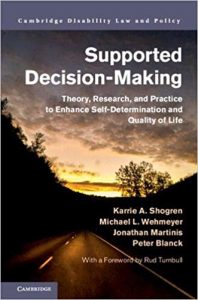 The United Nations Convention on the Rights of Persons with Disabilities (CRPD) recognized that people with disabilities should have the right to exercise their legal capacity and identified ‘supported decision-making’ as a means by which people with disabilities can be directly involved in decisions that impact their lives. Offering an overview of its emergence in the disability field and highlighting emerging research, theory, and practice from legal, psychology, education, and health fields, this volume provides a much-needed theoretical and evidence base for supported decision-making. Evidence and strengths-based frameworks for understanding disability, supports, and their roles in promoting supported decision-making are synthesized. The authors describe the application of a social-ecological approach to supported decision-making, and focus on implications for building systems of supports based on current environmental demands. This volume introduces and explains empirical research on critical elements of supported decision-making and the applications of supported decision-making that enhance outcomes, including self-determination and quality of life.