Emerald Publishing Limited has announced the release of Disability and the Future of Work, a groundbreaking edited volume that examines how disability intersects with the rapidly changing world of work. Edited by DEP investigators—Fitore Hyseni, Lisa Schur, Douglas Kruse, and Peter Blanck—the book brings together leading scholars and practitioners to explore how technological, economic, and policy transformations are reshaping employment opportunities for people with disabilities. Continue Reading
Publications
New Report Prepared for Syracuse University’s Lender Center for Social Justice – Disability as a Critical Element in Exploring the Racial Wealth Gap
This report examines the racial wealth gap for people with disabilities in the United States. While the racial wealth gap is well-documented, with the median White household having a net worth 7-10 times higher than the median Black household, the wealth gap experienced by people with disabilities remains less explored. Recent data show that households without disabilities possess, on average, 6 times the net worth of households led by a working-age person with a disability. Wealth, defined as total household assets minus total liabilities, is a comprehensive measure of economic well-being and social stratification, and it has wide implications, including for personal security and long-term health and well-being. For people with disabilities, wealth has an added dimension, as additional costs associated with living with a disability reduce the amount individuals can save over their lifetime.
Continue Reading
New Research Brief – Lingering Inequalities in the Information Age: An Examination of Disparities in Internet Access Among People with Disabilities
When the Americans with Disabilities Act (ADA) was enacted in 1990, the internet was in its infancy. We could not imagine how technology would change the way we interact with government services, our employer, our doctor, or the way we shop. However, the “information age” comes with structural barriers for people with disabilities. These barriers include inaccessible web sites, a lack of reliable internet connectivity, and high prices for internet service. Continue Reading
New Publication – BBI’s Senior Director for Law and Policy Jonathan Martinis featured in an article by the ABA today. Addressing the School-to-Guardianship Pipeline
Approximately 1.5 million adults are under active guardianship or conservatorship, according to Bloomberg Law. An unknown number of these adults are young adults with disabilities, often intellectual and/or developmental disabilities (I/DD). These young adults are often funneled into guardianship by what the National Council on Disability (NCD) in its 2018 report called the “school-to-guardianship pipeline,” a phenomenon where schools are, by default, recommending to parents that they start the process of assuming guardianship over their disabled child before they become an adult. Continue Reading
New Research Brief – Exploring Disparities in Poverty Rates Among People with Disabilities
The Americans with Disabilities Act (ADA) was enacted in 1990 to promote, among other goals, economic self-sufficiency for people with disabilities. Nevertheless, many people with disabilities do not achieve this goal. In fact, people with disabilities and other underserved groups are disproportionately affected by poverty. Research shows that having a disability results in a higher risk of experiencing poverty. Underlying explanations point to people with disabilities not only having fewer opportunities for well-paying jobs, but also having extra costs associated with their disabilities, including medical treatment, care, housing, and transportation. Despite this well-established link between poverty and disability, the relationship between these factors and other characteristics such as race, ethnicity, and gender, remains understudied. Continue Reading
New Research Brief – Dismantling Barriers: How Disability, Race, and Other Characteristics Influence Employment Outcomes
Because understanding intersectionality is critical in creating inclusive and effective policies and practices that reach all people with disabilities, we at the Southeast ADA Center are undertaking a four-part research project to identify the ways in which multiple forms of discrimination can intersect and compound and lead to disparate ADA-related outcomes. Continue Reading
New Publication by Southeast ADA team – The Americans with Disabilities Act and Medication Assisted Treatment in Correctional Settings.
Studies estimate that least 65% of people incarcerated in the United States have Substance Use Disorder (SUD). Medication Assisted Treatment (MAT) is a proven effective treatment for Opioid Use Disorder (OUD). MAT reduces the number of people who die each year from OUD by fifty percent and ninety percent of individuals in recovery maintain sobriety after two years. Title II of the Americans with Disabilities Act (ADA) covers the programs and services provided by state and local governments including correctional facilities. Under the ADA, correctional facilities must make reasonable modification to policies and practice to allow inmates in recovery to have access to MAT. In this article, we discuss how the ADA applies to correctional facilities and the impact that MAT has for people who have OUD.
Authors: Pamela Williamson and Barry Whaley
Keywords: Americans with Disabilities Act; ADA; Addiction; Substance use; Opioid use; Recovery;
Medication-Assisted Treatment; Medications for Opioid Use Disorder; Jails; Prisons; Correctional facilities
Read Full article: The Americans with Disabilities Act and Medication Assisted Treatment in Correctional Settings.
New Publication – The Americans with Disabilities Act and Equal Access to Public Spaces by Burton Blatt Institute Leeds Team
Since the passage of the landmark Americans with Disabilities Act of 1990, the United States federal government, states, and localities have passed laws and created policies intended to ensure that people with disabilities had full and equal access to public spaces. Nevertheless, more than three decades after the ADA, people with disabilities continue to face architectural and other barriers to community inclusion and participation. Continue Reading
Peter Blanck’s New Book – Advanced Introduction to U.S. Disability Law
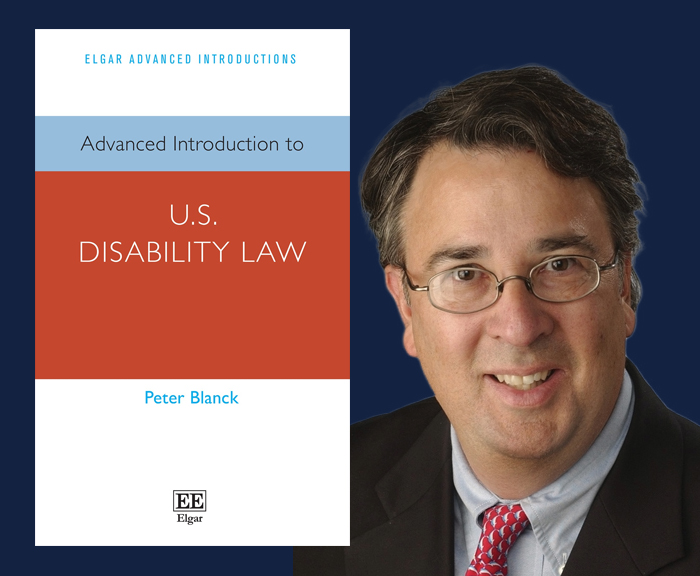 Advanced Introduction to U.S. Disability Law provides a timely and accessible overview of disability law in the United States, focusing primarily on the Americans with Disabilities Act of 1990 (the ‘ADA’). Peter Blanck addresses the social and legislative history leading up to the development of the ADA; coverage and remedies under the ADA’s three main titles; some of the fundamental and recent cases informing the ADA’s interpretation; and current issues facing U.S. courts, law makers, and policy makers.
Routledge Handbook of Disability Law and Human Rights, edited by Peter Blanck and Eilionoir Flynn, published
July 27, 2016
This handbook provides a comprehensive and authoritative state-of-the-art review of the current and emerging research and policy on disability law. Continue Reading