Supported Decision-Making: Theory, Research, and Practice to Enhance Self-Determination and Quality of Life

Supported Decision-Making: Theory, Research, and Practice to Enhance Self-Determination and Quality of Life

Karrie Shogren, Michael Wehmeyer, Jonathan Martinis, Peter Blanck

Karrie Shogren, Michael Wehmeyer, Jonathan Martinis, Peter Blanck. (2019). Supported Decision-Making: Theory, Research, and Practice to Enhance Self-Determination and Quality of Life. Cambridge University Press.


Visit Website
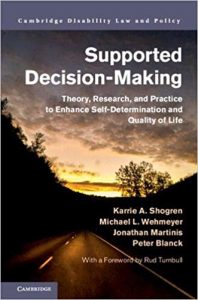
Suported Decision Making Book CoverThe United Nations Convention on the Rights of Persons with Disabilities (CRPD) recognized that people with disabilities should have the right to exercise their legal capacity and identified ‘supported decision-making’ as a means by which people with disabilities can be directly involved in decisions that impact their lives. Offering an overview of its emergence in the disability field and highlighting emerging research, theory, and practice from legal, psychology, education, and health fields, this volume provides a much-needed theoretical and evidence base for supported decision-making. Evidence and strengths-based frameworks for understanding disability, supports, and their roles in promoting supported decision-making are synthesized. The authors describe the application of a social-ecological approach to supported decision-making, and focus on implications for building systems of supports based on current environmental demands. This volume introduces and explains empirical research on critical elements of supported decision-making and the applications of supported decision-making that enhance outcomes, including self-determination and quality of life.

“The Right to Make Choices”: Supported Decision-Making Activities in The United States.

Peter Blanck & Jonathan Martinis


Blanck, P. & Martinis, J. (2019). “The Right to Make Choices”: Supported Decision-Making Activities in the United States, 27-38, in The Will of the Protected Person: Opportunities, Risks and Safeguards (ed. M. Pereña Vicente).


Download Publication

Research shows that self-determination and the right to make life choices are key elements for a meaningful and independent life. Yet, older adults and people with disabilities are often placed in overly broad and restrictive guardianships, denying them their right to make daily life choices about where they live and who they interact with, their finances, and their health care. Supported decision-making (SDM)—where people use trusted friends, family members, and professionals to help them understand the situations and choices they face, so they may make their own decisions—is a means for increasing self-determination by encouraging and empowering people to make decisions about their lives to the maximum extent possible. This article examines the implications of overly broad guardianship and the potential for supported decision-making to address such circumstances. It introduces the National Resource Center for Supported Decision-Making as one means to advance the use of supported decision-making and increase self-determination.

Celestia Ohrazda

Celestia Ohrazda is an Information Design Specialist. Her professional experience and interests focus on the accessibility and usability of web-based technologies and the adoption of innovations, specifically media-rich technologies. She joined BBI in 2009, and her primary responsibilities include the design and development of BBI’s primary and subsidiary websites, support of distance learning technologies, design and evaluation of survey instrumentation, and the creation and assurance of accessible electronic products. She works across many of BBI’s projects and has a particularly central role in the Southeast ADA Center.

Celestia’s experience as a designer and producer of web-based technologies, coupled with her experience as a researcher, provides her with a unique perspective as a scholar who brings multiple methodologies to bear on the design, dissemination, and evaluation of technology-driven interventions.

Celestia holds a B.A. in English, an M.S. and a Certificate of Advanced Study (C.A.S) in Instructional Design, Development and Evaluation from Syracuse University.

Supported Decision-Making: Implications from Positive Psychology for Assessment and Intervention in Rehabilitation and Employment

Hatice Uyanik, Karrie Shogren, and Peter Blanck

Uyanik, H., Shogren, K.A. & Blanck, P. J (2017). Supported Decision-Making: Implications from Positive Psychology for Assessment and Intervention in Rehabilitation and Employment. Journal of Occupational Rehabilitation. (27)4. 498–506. https://doi.org/10.1007/s10926-017-9740-z


Download Publication
Visit Website

Purpose This article reviews existing literature on positive psychology, supported decision-making (SDM), employment, and disability. It examines interventions and assessments that have been empirically evaluated for the enhancement of decision-making and overall well-being of people with disabilities. Additionally, conceptual themes present in the literature were explored.
Methods A systematic review was conducted across two databases (ERIC and PsychINFO) using various combination of keywords of ‘disabilit*’, work rehabilitation and employment terms, positive psychology terms, and SDM components. Seven database searches were conducted with diverse combinations of keywords, which identified 1425 results in total to be screened for relevance using their titles and abstracts. Database search was supplemented with hand searches of oft-cited journals, ancestral search, and supplemental search from grey literature.
Results Only four studies were identified in the literature targeting SDM and positive psychology related constructs in the employment and job development context. Results across the studies indicated small to moderate impacts of the assessment and interventions on decision-making and engagement outcomes. Conceptually there are thematic areas of potential overlap, although they are limited in the explicit integration of theory in supported decision-making, positive psychology, disability, and employment.
Conclusion Results suggest a need for additional scholarship in this area that focuses on theory development and integration as well as empirical work. Such work should examine the potential utility of considering positive psychological interventions when planning for SDM in the context of career development activities to enhance positive outcomes related to decision-making, self-determination, and other positive psychological constructs.​

Supported Decision-Making: Implications from Positive Psychology for Assessment and Intervention in Rehabilitation and Employment

Purpose This article reviews existing literature on positive psychology, supported decision-making (SDM), employment, and disability. It examines interventions and assessments that have been empirically evaluated for the enhancement of decision-making and overall well-being of
people with disabilities. Additionally, conceptual themes present in the literature were explored.
Methods A systematic review was conducted across two databases (ERIC and PsychINFO) using various combination of keywords of ‘disabilit*’, work rehabilitation and employment terms, positive psychology terms, and SDM components. Seven database searches were conducted with diverse combinations of keywords, which identified 1425 results in total to be screened for relevance using their titles and abstracts. Database search was supplemented with hand searches of oft-cited journals, ancestral search, and supplemental search from grey literature.
Results Only four studies were identified in the literature targeting SDM and positive psychology related constructs in the employment and job development context.  Results across the studies indicated small to moderate impacts of the assessment and interventions on decisionmaking and engagement outcomes. Conceptually there are thematic areas of potential overlap, although they are limited in the explicit integration of theory in supported decisionmaking, positive psychology, disability, and employment.
Conclusion Results suggest a need for additional scholarship in this area that focuses on theory development and integration as well as empirical work. Such work should examine the potential utility of considering positive psychological interventions when planning for SDM in the context of career development activities to enhance positive outcomes related to decision-making, self-determination, and other positive psychological constructs.