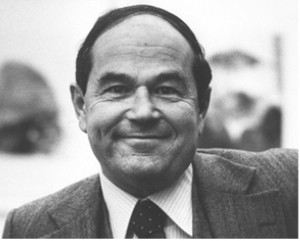
Burton Blatt (1927–1985) was a pioneer in humanizing services for people with intellectual disabilities. As an advocate of deinstitutionalization, he helped initiate community living programs and family support services. In his clinical work he emphasized the provision of education to children with severe disabilities, those whom he called “clinically homeless.” As a national leader in special education, he called for programs to integrate students with disabilities into public schools and worked to promote a more open society for them.
His career led him to become a nationally recognized leader and university administrator, but Blatt remained a teacher most of all. He is perhaps best remembered as author of the photographic exposé Christmas in Purgatory (1966), a searing portrait of life in a mental institution that brought national attention to the abuse of people with intellectual disabilities in America’s institutions; and the follow-up study, The Family Papers: A Return to Purgatory (1979). In these and more than 300 other books, chapters, and articles, he emphasized the humanity of all people, regardless of the nature or severity of their disabilities.
Download Christmas in Purgatory [PDF]
Blatt received numerous awards from governmental, professional, university, and family organizations for his service on behalf of people with disabilities and their families, and held a variety of leadership roles in professional organizations.
Burton Blatt Papers presented by Syracuse University Archives
The archival Collections and Personal Papers of Burton Blatt cover the professional portion of Blatt’s life as teacher, administrator and advocate for the disabled, but also shed light into Blatt as an individual. The collection consists of 121 boxes (75 linear feet). Please note that the collection is housed off-site and advance notice is required to allow time to have the materials brought to the Reading Room. Burton Blatt: An inventory of his papers at the Syracuse University Archives
Videos about Burton Blatt


How Disability Studies Began at Syracuse University: A Brief History
Burton Blatt was appointed director of the Division of Special Education and Rehabilitation at Syracuse University’s School of Education in 1969. Blatt had recently published what became a famous photographic exposé of institutions, Christmas in Purgatory (1966). As children continued to be abused and denied access to education within state institutions, Blatt continued to publish works that exposed these realities. In his research, writing, teaching, and service, Blatt called consistently for widespread institutional transformation and systemic reform.
Students from one of his six-week graduate seminars at Syracuse University were sent to observe facilities for persons with what was then referred to as mental retardation. Students in this seminar collected over 10,000 pages of field notes that were edited into a final report. This report was thereafter formalized into a monograph. The monograph was used to lobby in Washington, DC, providing testimony about the egregious circumstances that needed to be studied further, addressed, and resolved. As a consequence of this testimony, Blatt received a generous HEW grant, the funding from which was used to create the Center on Human Policy at Syracuse University.
The seeds for the Center on Human Policy’s genesis were thus borne directly from an academic seminar taught by Blatt, in combination with his other work. The Disability Studies program at Syracuse University was also a direct consequence of these labors. The Disability Studies program’s founding Director, School of Education Centennial Professor Steve Taylor (1949-2014), who was the Center’s third Director, had a foundational role in the new and burgeoning interdisciplinary field of Disability Studies. Disability Studies at Syracuse in turn motivated and continues to influence the creation of similar programs across the United States and globally.
Taylor wrote about Blatt in order to provide helpful and important context about what Blatt had done during his tenure at Syracuse. He described Blatt as one of a handful of leaders in the field (special education and “mental retardation”) to challenge institutional abuse and to advocate for alternative approaches and perspectives. As Taylor highlighted, Blatt and others in his cohort not only exposed deplorable conditions, they ultimately revealed that the institutional model was not sustainable, and advocated openly for institutions to close.
During the mid-1960s, predominantly white men—including Blatt—held prominent positions that made it possible for them to play leadership roles, before the self-advocacy or disability rights movements (DRM) had become firmly established. In fact, it wasn’t until after the exposé by Blatt and photographer Fred Kaplan, as well as other work by academics at the time (including Wolf Wolfensberger, Bengt Nirje, and Gunnar Dybwad, among others) that deplorable conditions in institutions were even remotely taken seriously, despite the fact that these conditions had been exposed, before. Taylor’s Acts of Conscience details a great deal of this history.
In the late 1960s, when Blatt came to Syracuse, he was one of the few leaders in the field who began to translate scholarly concepts and theories into a philosophy of caring for people labeled with mental retardation (what we would now call intellectual disability). This orientation was new and innovative; simultaneously, these scholarly contributions were not the only important ones. Blatt was a humanist, and his major contributions during this time period were moral and ethical ones. Not only did he seek to improve the professional field, he sought to motivate and inspire people to be better human beings.
Some of the early ideas and theories set forth by Blatt, others in the field, and those who studied with him did important work to shift the focus from deficits to strengths, particularly in a social and cultural context. In fact, their work directly informed theory, practice, and activism. The idea that disability is a social construct, and other early concepts (such as labeling, stigma, and the medical model), together created a solid foundation for an interdisciplinary area of inquiry that would later be called Disability Studies.
References
Biklen, D. (Ed.). (1970). Observing in Institutions; Human Report #1: Observations in Mental Health-Mental Retardation Facilities. Syracuse, NY: Division of Special Education and Rehabilitation, School of Education, Syracuse University in collaboration with the Workshop on Human Abuse, Protection and Public Policy.
Blatt, B., & Kaplan, F. (1974). Christmas in Purgatory: A Photographic Essay on Mental Retardation [reprint edition]. Syracuse, NY: Human Policy Press.
RTC Media. (2016, March 1). Extended interview – Steve Taylor [Video file]. Retrieved from: https://youtu.be/gmpV6nRy1Vo.
Taylor, S. J. (2006, April). Christmas in Purgatory: A retrospective look [Perspectives]. Mental Retardation, 44(2), 145-149.
Taylor, S. J. (2008). Foreword: Before It Had a Name: Exploring the Historical Roots of Disability Studies in Education. In S. Danforth & S. L. Gabel (Eds.),Vital questions facing disability studies in education [Disability Studies in Education Series] (pp. xiii-xxiii). New York: Peter Lang.
Taylor, S. J. (2009). Acts of Conscience: World War II, Mental Institutions, and Religious Objectors [Critical Disability Studies Series]. Syracuse, NY: Syracuse University Press.